

Info@DoctorTrev.com
ArticlesResearch Methods3 min read

Different Levels of Research Evidence

Different study designs provide different levels of evidence. Always inspect the methods section first to verify whether a claim rests on associative, correlational, or causal trial architecture.

Dr. Trevor Kouritzin

Ph.D. Medicine · M.Sc. Human Nutrition · B.Sc. Chem Eng

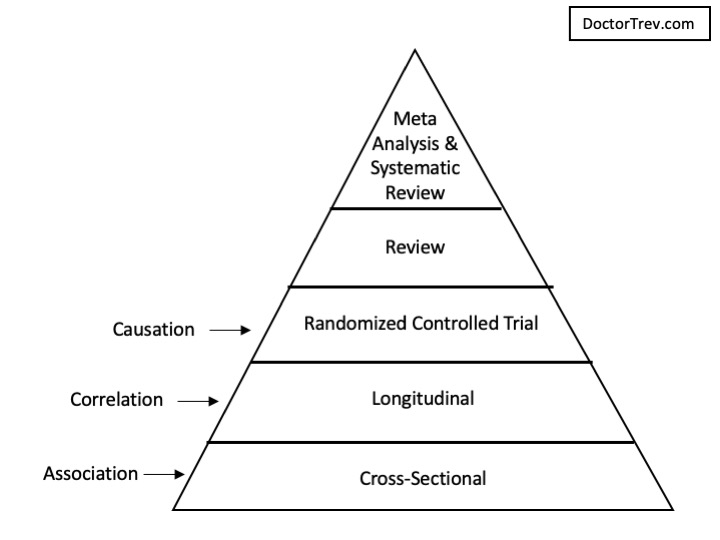
Hierarchy of scientific research evidence across study designs
Fig. — Hierarchy of scientific research evidence across study designs

Evidence Summary

Cross-sectional studies show association, longitudinal cohorts track correlation over time, and randomized controlled trials (RCTs) establish causal intervention efficacy.

Not all published papers carry equal evidentiary weight. Before applying a headline finding to clinical practice or supplementation, check the study’s methods section to see how the hypothesis was actually tested:

  • Cross-sectional studies examine a cohort at a single point in time, offering associative snapshots without temporal causality.
  • Longitudinal studies track a cohort across multiple time points, establishing temporal sequence and stronger correlational signals.
  • Randomized controlled trials (RCTs) assign an active intervention versus a control group, enabling causal inference.

Magnesium Case Studies Across Evidence Tiers

If you are unsure what kind of study you are reading, read the Methods section first to frame the results accurately. The three PubMed references below illustrate cross-sectional, longitudinal, and RCT designs applied to magnesium.

Primary References

  1. Study #1 — Cross-Sectional Magnesium Cohort. https://pubmed.ncbi.nlm.nih.gov/38703902/
  2. Study #2 — Longitudinal Magnesium Study. https://pubmed.ncbi.nlm.nih.gov/32667538/
  3. Study #3 — Randomized Controlled Trial on Magnesium. https://pubmed.ncbi.nlm.nih.gov/34260036/

Evidence Dispatch

Receive new study breakdowns via email