

Info@DoctorTrev.com
ArticlesEndocrinology3 min read

Does it Matter When You Sleep for Testosterone?

A 2005 clinical study published in The Journal of Clinical Endocrinology & Metabolism researched an important question: Is testosterone influenced more by when you sleep—or how long you sleep?

Dr. Trevor Kouritzin

Ph.D. Medicine · M.Sc. Human Nutrition · B.Sc. Chem Eng

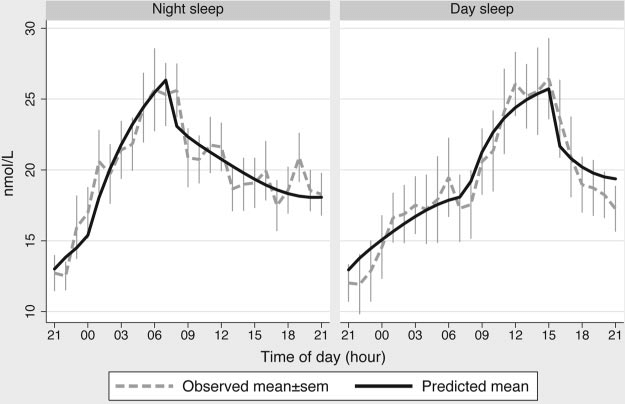
Observed and predicted testosterone levels for night sleep versus day sleep
Fig. — Observed and predicted testosterone levels for night sleep versus day sleep

Evidence Summary

Controlled 24-hour laboratory monitoring demonstrated that total sleep duration—rather than clock-time circadian alignment alone—was the primary driver of the sleep-induced testosterone rise (~15–17 to ~25–26 nmol/L).

A 2005 clinical study published in The Journal of Clinical Endocrinology & Metabolism researched an important question: Is testosterone influenced more by when you sleep—or how long you sleep?

Controlled Lab Design & Findings

In a controlled lab, 7 healthy men were monitored for 24 hours while sleeping either at night (11 PM–7 AM) or during the day (7 AM–3 PM).

  • Testosterone levels rose steadily in both conditions—from ~15–17 nmol/L to ~25–26 nmol/L.
  • Circadian rhythm exerted only a minor influence; total sleep duration was the primary driver of testosterone production.
  • For shift workers or irregular schedules, protecting uninterrupted sleep duration remains critical for endocrine recovery.

Primary References

  1. Axelsson et al. (2005). The Journal of Clinical Endocrinology & Metabolism. PubMed ID: 15914523. https://pubmed.ncbi.nlm.nih.gov/15914523/

Evidence Dispatch

Receive new study breakdowns via email