

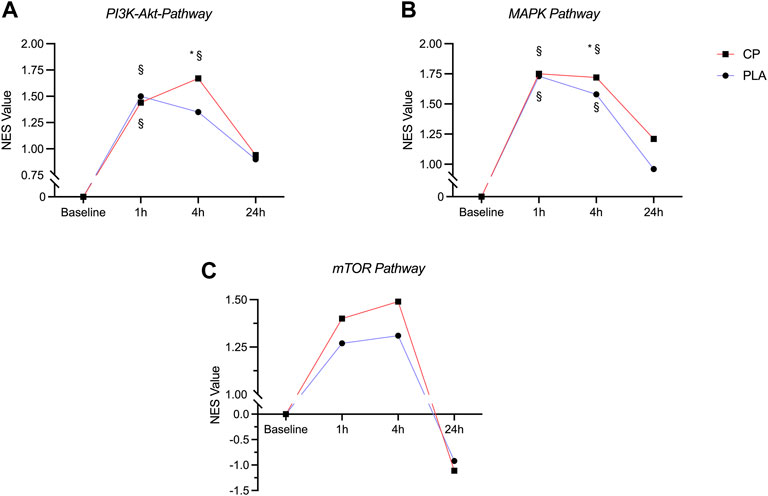
While it is true that collagen is low in leucine and does not strongly stimulate muscle protein synthesis (MPS) via mTOR, mTOR is not the only anabolic pathway that matters. Other signaling networks—such as PI3K/Akt and MAPK—play major roles in connective-tissue remodeling, tendon support, and muscle repair.
A 2022 randomized controlled trial in Frontiers in Physiology reported that 15 g of collagen peptides consumed after high-load resistance exercise significantly increased activation of both PI3K/Akt and MAPK versus placebo [1]. That is notable given many whey studies use ~30 g doses. These pathways are linked not only to muscle growth but also to strengthening the extracellular matrix—the “scaffolding” that transfers force from muscle to bone.
Beyond signaling, collagen is the most abundant protein in the body, accounting for ~30% of total protein [2]. The body contains at least 16 types of collagen distributed across skin, tendons, bone, cartilage, and other connective tissues.
Collagen is not ideal as your sole protein source, but it is far from useless. It targets complementary adaptation pathways. When paired with higher-leucine proteins throughout the day, collagen supports joint health, connective-tissue integrity, and overall structural resilience.