

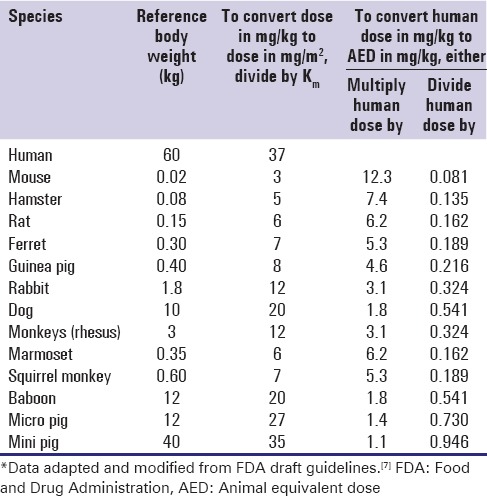
A common mistake in translating animal study dosages to humans is using simple body weight scaling (mg/kg). This ignores critical differences in metabolism, cardiac output, and physiology across species. Instead, allometric scaling—which accounts for body surface area and species-specific metabolic rates—should be used.
Nair and Jacob (2016) compiled standardized conversion factors (Km ratios) for the most commonly used animals in preclinical research. The formula for Human Equivalent Dose (HED) is: HED (mg/kg) = Animal dose (mg/kg) × Km ratio.
Worked Example Calculation
If a 200 g (0.2 kg) mouse is administered 10 mg of a compound, the animal dose is 10 mg / 0.2 kg = 50 mg/kg. Multiplying by the mouse-to-human Km ratio (0.081): HED = 50 mg/kg × 0.081 = 4.05 mg/kg for humans (~283.5 mg for a 70 kg adult).
Key takeaway: Body weight alone is misleading—smaller animals have dramatically faster metabolic rates, meaning humans require proportionally lower per-kilogram doses.